Subterranean termite treatment requires distinct structural protocols depending on the building era and foundation construction found across Pinellas County. In Historic Old Northeast and Kenwood, early 20th-century…
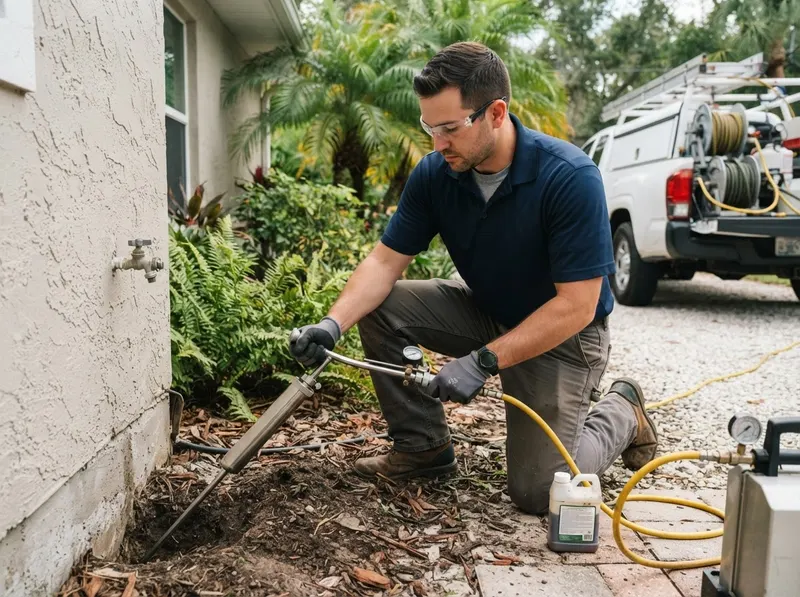
Subterranean termite treatment requires distinct structural protocols depending on the building era and foundation construction found across Pinellas County. In Historic Old Northeast and Kenwood, early 20th-century bungalows frequently sit on raised pier-and-beam foundations with active soil crawlspaces. In these environments, moisture under the subfloor draws native subterranean termites directly upward through masonry piers via protective mud shelter tubes. Remediation involves creating continuous liquid soil barriers at 4 gallons per 10 linear feet around every pier, alongside exterior foundation trenching, ensuring the colony cannot transit between soil moisture and untreated subfloor framing.
Slab-on-grade homes common to Euclid Heights, Disston Heights, Shore Acres, and Snell Isle demand a different delivery mechanism. Subterranean termites, including destructive Formosan colonies prevalent near coastal waterways like Crescent Lake and the Gulfport border, enter slab homes through 1/32-inch shrinkage cracks, bath traps, and plumbing penetrations hidden beneath tile or engineered flooring. Liquid soil barrier treatments surround the exterior stem wall, while precise interior slab drilling deposits non-repellent termiticide beneath high-risk wet areas. Unlike drywood termites which live entirely inside isolated lumber and require structural tent fumigation, subterranean species nest in the earth; fumigation gas leaves zero residual protection in the dirt, making soil treatments the required defense.
Treatment selection balances liquid soil barriers against in-ground bait station installations. Liquid non-repellent termiticides establish an immediate zone of protection around concrete slabs that foraging workers cross undetected, transferring the active ingredient back to the central subterranean queen. In-ground bait stations placed every 10 to 15 feet along the drip line provide perimeter intercept monitoring without drilling driveways or patios, though bait consumption and structural elimination require 60 to 90 days. Homes bordering coastal flood zones like Coquina Key often benefit from integrated approaches to withstand seasonal high water tables.
Every job gets a firm, written price after a free on-site visit.
Tell us about your subterranean termite treatment job in St. Petersburg and we'll send a clear, written quote, usually the same day.
 Suncoast Sparrow Pest Control