Roof rat (*Rattus rattus*) activity in Pinellas County spikes along mature tree lines where live oaks, date palms, and bougainvillea contact roof systems. In historic properties across Historic Old Northeast, Kenwood,…
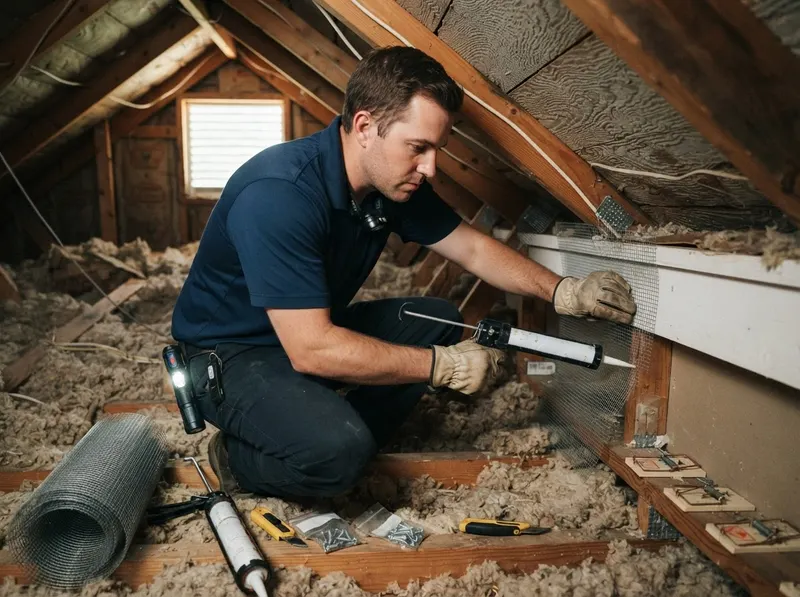
Roof rat (*Rattus rattus*) activity in Pinellas County spikes along mature tree lines where live oaks, date palms, and bougainvillea contact roof systems. In historic properties across Historic Old Northeast, Kenwood, and Crescent Lake, architectural construction often presents exposed rafter tails, barrel-tile gaps, and open soffits. These structural features allow roof rats easy arboreal pathways from tree canopies directly into attic air spaces. Sealing these entry points requires 16-gauge quarter-inch wire mesh and exterior construction-grade elastomeric sealant. The objective is denying physical entry, because over-the-counter bait boxes outside or unmonitored poisons inside create secondary odor issues when rodents perish unreachable inside wall voids during extreme Florida heat.
Properties near sea-level waterways, including Snell Isle, Shore Acres, and Coquina Key, face high ground-water tables and thick canal-side brush that drive rodents upward into drier insulation voids. Trapping alone without permanent exclusion creates an open corridor for replacement colonies within 3 to 6 weeks. A complete exclusion strategy pairs custom-bent metal flashing along drip lines with systematic snap-trapping along confirmed attic travel runs. The trade-off between exterior trapping and structural exclusion is labor duration: simple trapping addresses the active population over 7 to 14 days, whereas structural exclusion permanently hardens the building perimeter against recurring entry.
Around Disston Heights, Euclid Heights, and properties along the St. Petersburg side of the Gulfport border, attic insulation frequently sustains damage from gnawing along electrical conduits and ductwork. Inspection protocols identify urine rub marks, dark spindle-shaped droppings measuring 0.5 inches, and gnawed wood framing. Traps rely on mechanical trip mechanisms positioned perpendicular to joists, checked across multiple cycles until zero activity registers. The process excludes exterior poisons that pose secondary toxicity risks to neighborhood raptors, domestic cats, and family dogs. Structural integrity is confirmed through a smoke or light test before finishing service visits.
Every job gets a firm, written price after a free on-site visit.
Tell us about your roof rat attic exclusion and trapping job in St. Petersburg and we'll send a clear, written quote, usually the same day.
 Suncoast Sparrow Pest Control