Silverfish (Lepisma saccharinum) and firebrats (Thermobia domestica) are ancient, wingless bristletails that metabolize cellulose, polysaccharides, and starches found in book bindings, drywall paper, and natural…
Silverfish (Lepisma saccharinum) and firebrats (Thermobia domestica) are ancient, wingless bristletails that metabolize cellulose, polysaccharides, and starches found in book bindings, drywall paper, and natural fabrics. In St. Petersburg, Florida, these pests encounter sustained ambient humidity levels exceeding 70 percent, providing continuous reproductive conditions. Historic 1920s Craftsman bungalows in Kenwood and Historic Old Northeast feature subfloor ventilation gaps, lath-and-plaster wall cavities, and elevated crawl spaces that preserve microclimates ideal for silverfish survival. Conversely, firebrats prefer high-temperature zones above 90 degrees Fahrenheit alongside sustained moisture, routinely nesting inside poorly ventilated roof attics, furnace closets, and behind commercial ranges along the Gulfport border and Disston Heights.
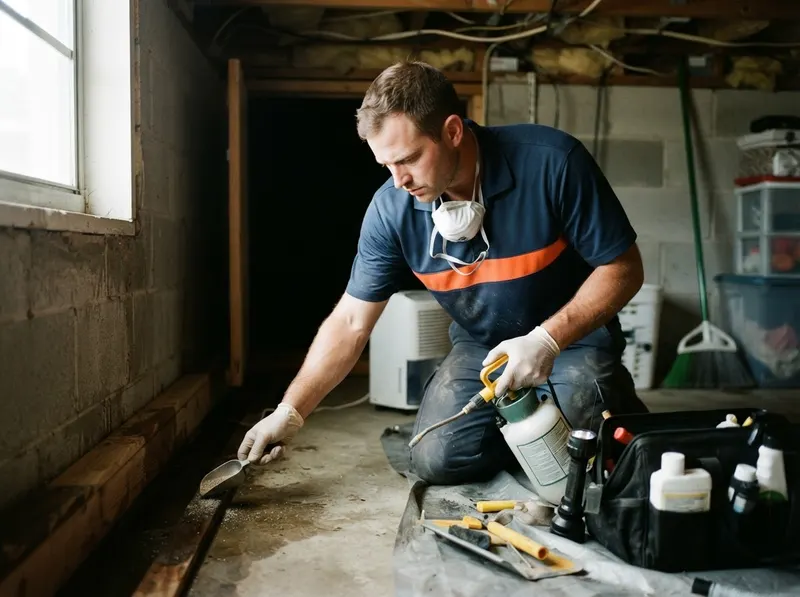
The mechanical application relies on non-volatile, synthetic desiccant formulations rather than continuous broad-spectrum chemical misting. Technicians inject amorphous silica gel and technical-grade sodium fluosilicate into structural cavities behind tile baseboards, plumbing chases, and under-cabinet kick plates. Amorphous silica removes the waxy lipid layer from the insect's epicuticle, causing rapid dehydration within 24 to 72 hours without emitting ambient airborne toxins. This mechanical mode of action prevents the chemical resistance commonly seen with standard pyrethroid shelf sprays. Furthermore, non-staining inorganic dust remains effective inside dry wall cavities for several years, providing extended residual exclusion beneath subflooring in low-elevation, flood-prone neighborhoods like Shore Acres, Snell Isle, and Coquina Key.
Selecting localized void injection over continuous fogging addresses the exact biology of Zygentoma species. Total-release foggers fail to reach behind baseboards, medicine cabinets, and deep attic blown-in cellulose where eggs incubate for 30 to 60 days. The operational trade-off requires opening interior cabinetry and attic scuttles to deliver precise physical deposits, requiring direct access rather than generalized perimeter broadcast. When properties near Crescent Lake and Euclid Heights experience recurrent plumbing leaks or high roof condensation, the treatment targets the moisture vector first; reducing localized relative humidity below 50 percent stops juvenile silverfish nymphs from completing their nymphal molts, breaking the re-infestation cycle permanently.
Every job gets a firm, written price after a free on-site visit.
Tell us about your silverfish and firebrat moisture defense job in St. Petersburg and we'll send a clear, written quote, usually the same day.
 Suncoast Sparrow Pest Control