German cockroach remediation addresses indoor breeding colonies that nest exclusively near moisture and food sources, distinct from the large outdoor smokybrown or American roaches common along coastal Pinellas County.…
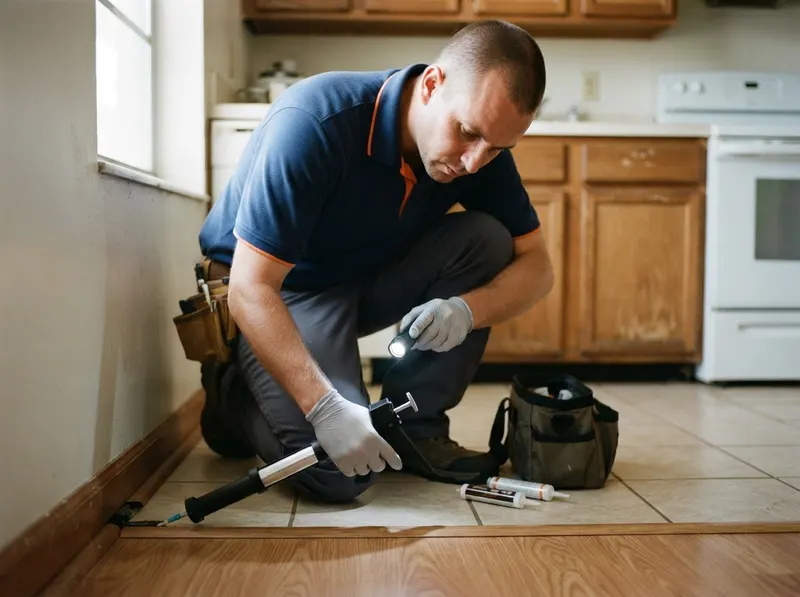
German cockroach remediation addresses indoor breeding colonies that nest exclusively near moisture and food sources, distinct from the large outdoor smokybrown or American roaches common along coastal Pinellas County. A single female carries an ootheca containing 30 to 40 eggs, resulting in exponential colony spikes inside warm, humid kitchens and bathrooms across older wood-frame bungalows in Kenwood and Historic Old Northeast. Over-the-counter pyrethroid aerosol foggers trigger behavioral scattering, driving breeding nymphs deeper into hollow drywall partitions, behind electrical outlets, and inside kitchen cabinet hinge pockets. Professional remediation uses non-repellent active ingredients paired with insect growth regulators so foraging nymphs transfer lethal actives back to the harborage aggregation.
A targeted flush-and-bait protocol fits active indoor infestations with visible daylight activity, nymph presence inside refrigerator compressor coils, or fecal spotting along cabinet seams. Outdoor perimeter spray treatments fail entirely against German roaches because this species lives, breeds, and feeds entirely within the conditioned indoor footprint. The functional trade-off requires upfront resident cooperation: dry pantry goods and cooking items must remain cleared from lower cabinetry for 14 days post-application so baits remain the sole competing food source.
Concrete block and slab-on-grade homes in Disston Heights and Euclid Heights experience distinct mechanical aggregation behind dishwasher insulation and sub-counter voids, whereas crawlspace piers and subfloor humidity in Crescent Lake and Coquina Key require focused treatment behind plumbing penetrations. In Shore Acres and Snell Isle, elevated indoor relative humidity accelerates nymph molt cycles, shortening development from egg to reproductive adult to approximately 60 days. Addressing harborages directly eliminates the population at the reproductive core rather than masking activity with standard exterior surface barriers.
Every job gets a firm, written price after a free on-site visit.
Tell us about your german cockroach remediation job in St. Petersburg and we'll send a clear, written quote, usually the same day.
 Suncoast Sparrow Pest Control