Florida carpenter ants (Camponotus floridanus and Camponotus tortuguanus) do not ingest cellulose for nutrition like subterranean termites. Instead, they excavate smooth, sandpaper-clean galleries through moist,…
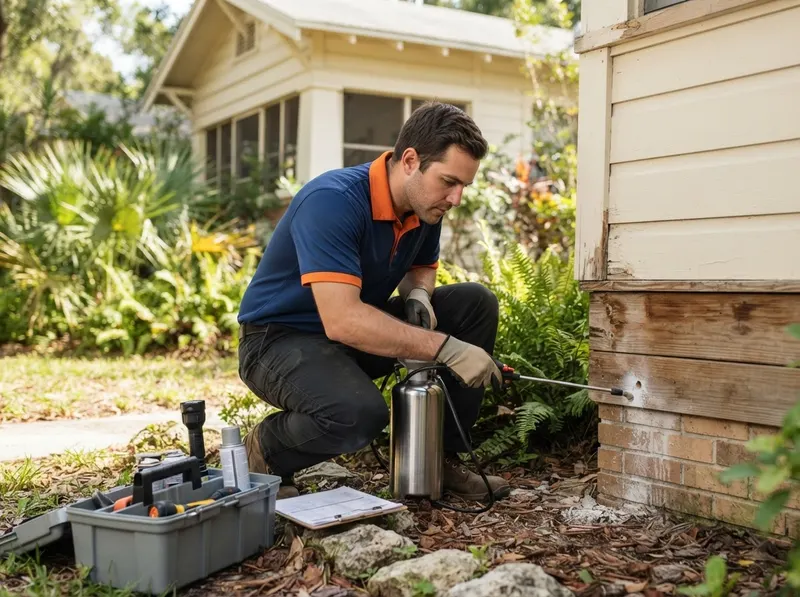
Florida carpenter ants (Camponotus floridanus and Camponotus tortuguanus) do not ingest cellulose for nutrition like subterranean termites. Instead, they excavate smooth, sandpaper-clean galleries through moist, softwood framing to house their satellite brood, depositing clean piles of fibrous frass mixed with insect parts beneath window sills and floor joists. In coastal St. Petersburg, structural vulnerability concentrates heavily in crawlspace foundations along the Gulfport border and historic 1920s heart-pine framing throughout Historic Old Northeast and Kenwood. Shore Acres, Snell Isle, and Coquina Key frequently sustain perimeter colony pressure following tidal surges and microburst rains, which soak facia boards, soffits, and flat-roof transitions, creating the damp structural conditions that female swarmers target between April and August.
Eradicating these colonies requires distinguishing structural wood damage from subterranean termite mud tubing. Carpenter ant galleries run parallel across soft growth rings, devoid of soil residue. Standard over-the-counter pyrethroid sprays disperse foraging workers and trigger colony budding, dividing a single satellite nest into three secondary nesting sites behind drywall in rooms such as kitchens and bathrooms. Professional treatment relies on slow-acting, non-repellent active ingredients (such as fipronil or chlorfenapyr) placed along documented worker trails leading from tree canopies near Crescent Lake, Euclid Heights, or Disston Heights directly into exterior structural penetrations. Foraging workers track these active transfers directly into the heart of the colony, achieving total population collapse across 14 to 21 days without saturating interior living quarters with broad-spectrum toxins.
Property owners face a direct operational trade-off between exterior perimeter tracking and interior wall-void injection. Exterior non-repellent barrier perimeters preserve indoor air quality and protect domestic pets from chemical contact, yet they require up to 3 weeks for full horizontal colony mortality. Direct wall injection achieves immediate local knockout within 48 hours using low-pressure aerosolized dry foams inside known wall voids, but requires drilling discrete 3/8-inch access points through wallboards beneath baseboard lines. When dense canopy cover from live oaks or palms overhangs rooflines near Sunken Gardens or Boyd Hill Nature Preserve, technicians combine direct localized void injections with exterior perimeter banding to isolate the structure permanently from parent nesting sites in the surrounding soil.
Every job gets a firm, written price after a free on-site visit.
Tell us about your carpenter ant structural eradication job in St. Petersburg and we'll send a clear, written quote, usually the same day.
 Suncoast Sparrow Pest Control